
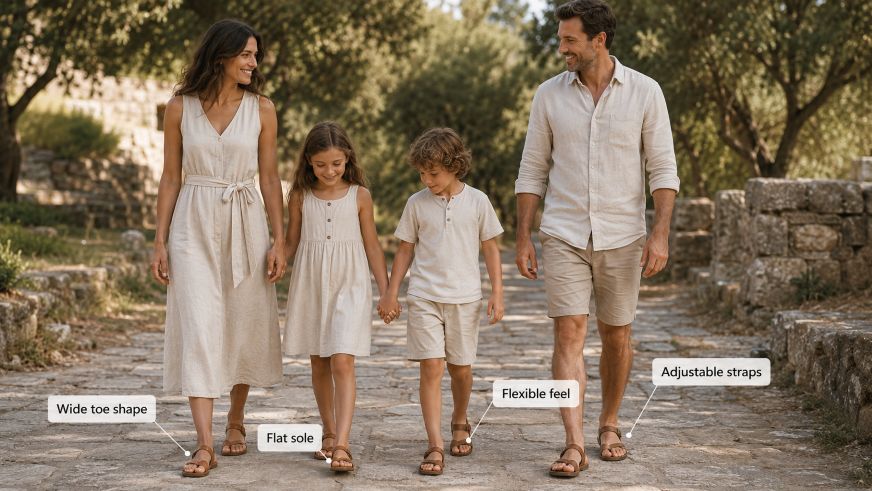
Footwear can affect how children walk and how their feet move. Narrow toe shapes, raised heels, stiff soles, and added structure may limit natural movement inside the shoe. For children, fit matters because their feet are still growing. The American Podiatric Medical Association advises parents to measure their children’s feet and choose shoes that fit comfortably from the start.
That concern helps explain renewed interest in simple sandal designs that take cues from older footwear. Styles such as Barefoot “Biblical-style” sandals (סנדלי תנכיות ברפוט) use the familiar idea of a flat sole held to the foot with a small number of straps. The look feels ancient, but its appeal today is practical and visual. A simple silhouette can work for different ages while leaving room for natural foot shape and movement.
What Did Ancient Sandals Actually Look Like?
Surviving sandals show that simple footwear is far from a modern invention. The British Museum holds ancient Egyptian examples made from reed, palm leaf, papyrus, and leather. Some have toe and ankle straps, while others use a thin sole shaped around the foot. The Metropolitan Museum of Art also records children’s sandals from New Kingdom Egypt made from leather and plant fibers.
These objects came from different periods and purposes, so today’s “Biblical-style” label is not an exact archaeological category. Still, the broad silhouette is recognizable. The foot sits on a flat base, the upper is open, and straps keep the sandal in place. That simplicity continues to influence modern summer footwear.
Why Does the Shape Matter for Families?
A family’s shoe needs vary by age and routine. Toddlers are learning balance. School-age children need footwear for active days. Adults may want something comfortable for walking that also works with everyday clothes. A sandal with fewer rigid parts can meet some of those needs when the fit and sole suit the wearer and activity.
Research supports paying attention to flexibility and shape rather than appearance alone. A 2023 systematic scoping review published in Healthcare examined 19 studies on children’s footwear. The authors found that shoe flexibility and sole hardness can affect gait and foot movement. They also noted that light, wide, flexible minimalist designs may reduce some differences between barefoot and shod movement, although more research is needed.
What Changes When Footwear Becomes More Minimal?
Minimal footwear usually removes features such as thick cushioning, large heel-to-toe height differences, and strong arch support. That does not automatically make every minimal shoe healthier. Fit, walking surface, activity level, age, and individual foot needs still matter.
A 2021 study published in Scientific Reports found that six months of normal daily activity in minimal footwear increased foot strength in healthy adults. The researchers did not argue that one shoe type suits everyone. Their findings simply suggest that footwear allowing the foot to work more actively can influence muscle function.
For young children, the American Academy of Pediatrics takes a practical approach. Its HealthyChildren guidance says first outdoor shoes should be comfortable, flexible, nonslip, and roomy enough for growth. It also notes that average children do not need special wedges, arch inserts, reinforced heels, or similar shaping features to learn to walk.
How Does an Ancient-Looking Sandal Fit Modern Family Style?
The attraction is partly visual. A plain leather or neutral sandal can work with dresses, shorts, linen clothing, jeans, and simple children’s outfits. Families who enjoy a coordinated family style can also choose sandals with similar shapes or materials across different sizes. This creates a shared look without requiring everyone to wear exactly the same shoes.
There is also a practical side. Open sandals make it easier to see whether toes are being crowded, while adjustable straps can help with small differences in foot volume. However, open footwear gives less protection from rough ground, sharp objects, or cold weather. Families still need closed shoes for many activities.
What Should Families Look for Before Buying?
Ancient inspiration matters only when the modern shoe fits well. The American Podiatric Medical Association recommends measuring both feet, buying for the larger foot, and checking regularly because children’s sizes can change quickly. Guidance from Dorset HealthCare University NHS Foundation Trust also advises leaving about a thumb’s width of space beyond the longest toe and making sure the shoe matches the foot’s width.
- Choose a toe area that does not squeeze the toes.
- Check that the straps hold the foot without rubbing.
- Look for enough flexibility for comfortable movement.
- Match sole thickness and grip to the activity.
- Recheck children’s fit often as their feet grow.
Ancient sandal silhouettes remain relevant because they show how little footwear may need to do at its most basic: protect the sole and stay attached to the foot. Modern families have better materials, sizing knowledge, and more choices. The useful lesson is not to copy the past exactly. It is to choose footwear that respects foot shape, suits daily life, and feels comfortable for each person wearing it.